|
1-Hour Programs (choose 1)
Adaptations: In the Adaptations lab, students will observe and identify different physical adaptations (scales, mouths, body shapes, and fin shapes) that fish use to help them successfully survive in their aquatic environment. They will gain an understanding of how physical structure(s) influences and determines function (i.e. a flounder's flat body will dictate its sedentary, bottom-dwelling position). (Grades 5-12)
Marine Mammals: NEW! Have you ever wondered how marine mammals know where to migrate or how they stay warm in sometimes frigid water? Join us during the Marine Mammals lab for an in-depth study of the adaptations that allow these fascinating creatures to survive in the vast oceans. Students will rotate through different stations to discover the advantages and disadvantages of teeth versus baleen in whales and will learn the importance of echolocation. Students will also be able to see and touch replica bones to distinguish which mammals they belong to! (Grades 7-12)
Field Water Chemistry: Students who participate in the Field Water Chemistry lab will measure several water quality parameters in the IGFA wetlands and determine the importance of each parameter to the environment. Once measurements are taken, students will assess the health of the water and experience some of the same struggles real field biologists encounter. (Grades 9-12) This program is not available as Outreach.
Ins & Outs of Ichthyology: In the Ins & Outs of Ichthyology lab, students will examine, in some detail, the external and internal anatomy of a fish. Only by dissecting can you really appreciate the structural and functional role of the many organs, fins, and other parts of a fish. Students will learn about the relationship between an organ's texture, location, and function. During the dissection, instructors will discuss how the different structures and organs function to aid the fish in its survival. Many aspects of its structural and functional organization are identical with those of other animals, including humans; this activity is designed to teach some of the differences and similarities of anatomy between fish and humans. (Grades 9-12)
Creatures of the Deep: NEW! In the Creatures of the Deep lab, students will identify the five layers of the ocean; Epipelagic, Mesopelagic, Bathypelagic, Abyssopelagic, and Hadalpelagic. They will learn what types of fish can be found at these great depths and understand how and why they are able to survive in such extreme conditions. Students will use what they learned to design their own species of deep sea creature using simple arts and crafts. (Grades K-3)
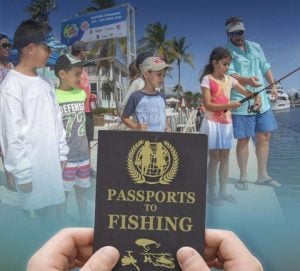
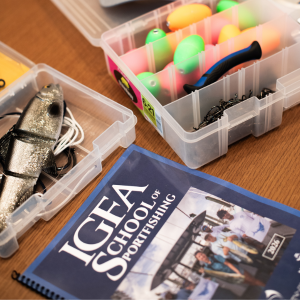
Fishing Clinic 1 (Equipment and Regulations): In the Fishing Clinic 1 program, students will learn the basic parts and functions of different rods and reels, the different types and functions of bait, different line classes, how to tie knots, Florida State regulations, catch and release techniques, and the safety that goes along with fishing. (Grades 3-12)
Sharks: During the Sharks lab, students will assess their existing knowledge about sharks and identify what information is fact and what is false. They will also determine the correct lengths of various shark species around the world. While working as a team, students will observe and identify different physical adaptations (tooth shape, tail shape, scent and electroreception) that sharks use to help them successfully survive in their aquatic environment. They will gain an understanding of what type of marine habitats sharks live in and why sharks are called the top predators in these habitats. (Grades 5-12)
Water Chemistry: In the Water Chemistry lab, students will measure several water quality parameters that are important to fish health: salinity, temperature, dissolved oxygen, nitrate, phosphate, and pH. Students will use a microscope to observe and identify invertebrates from the IGFA's wetland waters. (Grades 5-12)
|
1/2-Hour Programs (choose 2)
Marine Topography: NEW! Students taking part in the Marine Topography lab will learn that the bottom of the ocean is much bumpier than they thought! Various bottom formations will be discussed as well as different strategies used over centuries to measure ocean depth. Students will work in groups to measure and map a false ocean bottom using historical mapping techniques. A class discussion will follow highlighting the difficulty in measuring something that cannot be seen, as well as the importance of various ocean contours. (Grades 5-12)
Touch Tank: The Touch Tank will provide students a chance to get up close and personal with various types of creatures that inhabit South Florida's marine habitats. Students will have the opportunity to gently touch organisms commonly found in the mangroves, seagrasses, and coral reefs while learning how human interference has affected these habitats. Models depicting each habitat are used to teach the importance of these fragile ecosystems and that organisms depend on them for protection and food. (Grades K-12)
Enviroscape: With the Enviroscape, students become members of a coastal community where they learn how pollution affects the watershed. Students learn how the aquifer of South Florida cleans their drinking water and what they do everyday affects our habitat through learning about their watershed. (Grades 3-12)
Fish Play: The Fish Play is a great way to teach young children the importance of various habitats and how the shape of the fish determines the type of environment it can live in. Select students wear costumes and have scripts just like in a real play! (Grades K-3)
Fish Printing: Students who do Fish Printing, or as the Japanese call it, Gyotaku (guh-YO-tah-koo), learn the external morphology of a fish and construct an original piece of art to take home! (Grades K-6)
Wetlands: NEW! While participating in the Wetlands lab, students will observe the different habitats that are created by the variations in elevation. Participants will learn what a wetland is and the many components that make up a wetland, the different types of wetlands, identify plants and animals and become conscious of their impact on their local wetlands in South Florida, the Everglades . Hands-on activities include dip-netting and water sampling. (Grades K-12) This program is not available as Outreach
2 1/2-Hour Programs
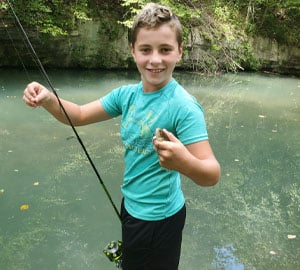
Fishing Clinic 2 (Hands-On Fishing): The Fishing Clinic 2 program incorporates the Fishing Clinic 1 program along with fishing in IGFA's front ponds. We provide all the equipment and bait needed while students apply what they've just learned about the basics of fishing in the IGFA's classroom. The cost for this program is $12/student. To run this special program, a minimum of 20 students is needed and chaperone assistance is required. For smaller or larger group sizes, please contact reservations@igfa.org. (Grades 3-12). This program is not available as Outreach
|