
Race Updates
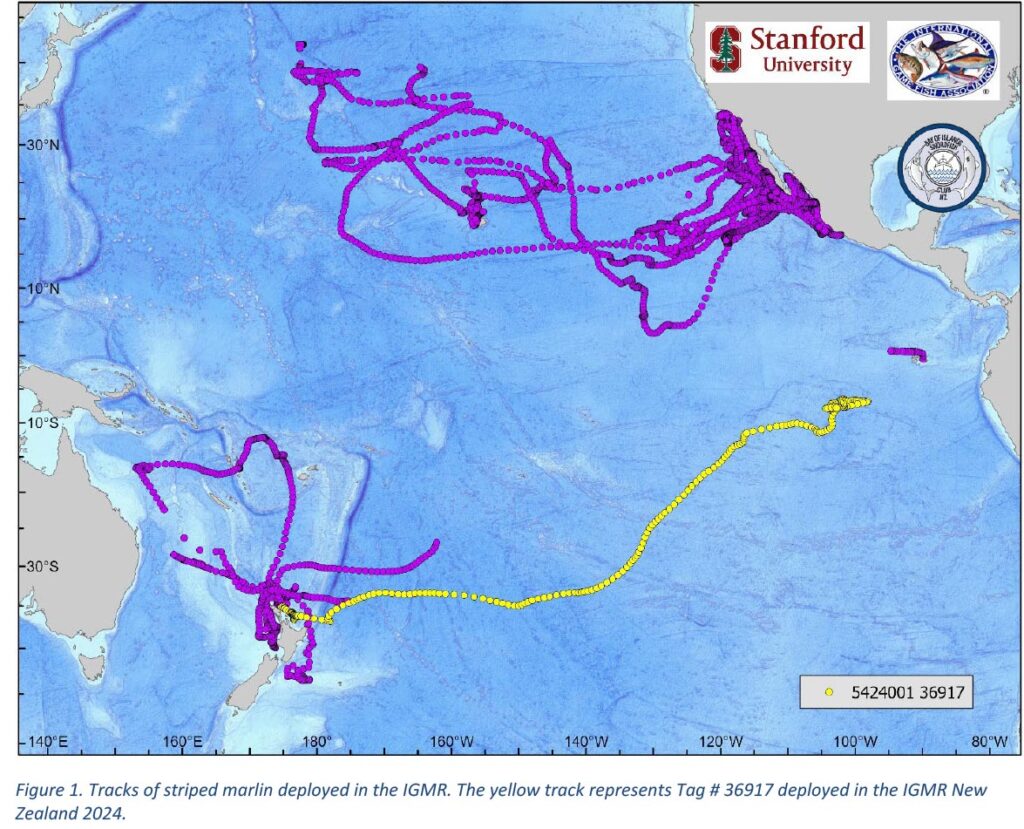
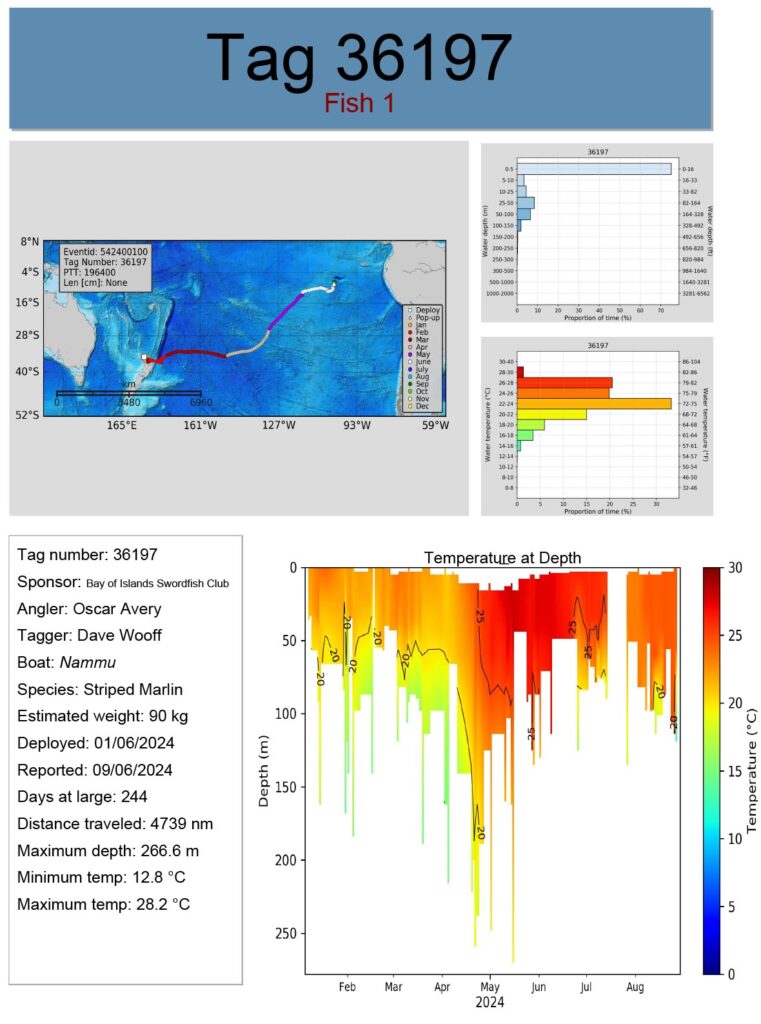
Tag 36197 was sponsored by The Bay of Islands Swordfish Club and deployed on January 6, 2024 off the northwest coast of New Zealand on a 90 kg striped marlin by Dave Wooff after a 40 minute fight with Oscar Avery while aboard Nammu with Captain Dave Wooff. Following the deployment, this fish traveled southeast near the coast for a month before turning east to head offshore. The fish then traveled a relatively straight path east and slightly south for four months. West of the Galapagos Islands, the fish ended its migration and began swimming within a small area for the next three months. The tag popped off on September 9, 2024 244 days after deployment and 4,739 nm from the tagging location with an estimated track length of 6,517 nm*.
Over the course of the deployment, this fish spent approximately 75% of the time within 10 m (33 ft) of the surface where the water temperature ranged between 19 and 28°C (66 – 82°F). Time at depth was greatest between 25 and 100 m (82 – 100 ft) where the water temperature ranged between 15 and 28°C (59 – 82°F). The deepest dive occurred on May 15, 2024 to a depth of 266 m (872 ft) where the water temperature was 19°C (66°F). The coldest water at 13°C (55°F) was experienced on February 8, 2024 at a depth of 167 m (548 ft).
The point-to-point distance of 4,739 nm represents the longest distance for a striped marlin in the IGMR database and third place on the all-time IGMR leaderboard. The majority of striped marlin tags have been deployed in the North Pacific and have shown relatively strong fidelity to their tagging region. The data from this tag demonstrates the ability of striped marlin to move between regions. Additional tagging from New Zealand will help to better understand the frequency and timing of these long-distance movements.
We are excited to add more data from striped marlin to the IGMR database and hope to increase this dataset in years to come. We are grateful to the tag sponsor and team effort that made this deployment so successful. These datasets help us to learn about billfish behavior in an effort to increase their conservation and protect the sport we love for future generations of fishing!