International Game Fish Association
  Login | Donate | Join
Last NameMember ID
IGFA Go Fish Museum Conservation Educate Give Join

All-Tackle Length Rules

  Click page PDF icon for downloadable PDF


 Click page PDF icon for dowloadable Record Application PDF

General Information
All fish entered for Length Records must be measured by anglers at the site of capture and released so that it swims away on their own and in good condition.  Fish should be revived by moving it forward in the water to ensure a healthy release.  Fish caught and entered for length records are not eligible for weighing and submission for other record categories.

Rules and Equipment Regulations
All IGFA rules and equipment regulations stipulated for fishing with conventional and fly tackle in fresh and saltwater shall apply with the exceptions below.  All angling and equipment regulations shall apply until the fish is measured and released alive.
 
A.  GAFFS & NETS
1.  The use of gaffs to land fish is prohibited.
2.  Nets used to boat or land a fish must not exceed 8 feet (2.44 meters) in over all length. (When fishing from a  bridge, pier or other high stationary structure, this length limitation does not apply.)
3.  The use of knotless, rubber coated nets or other similarly designed nets that minimize slime and scale removal is strongly recommended.
 
B. MEASURING DEVICE
 1. All fish must be measured using an official IGFA measuring device. (order yours at http://store.igfa.org/)
 2. The measuring device mat may be shortened by cutting it, but it may not be rejoined after it has been shortened.
 
 
Angling Regulations
The following acts will disqualify a catch:
1. Failure to comply with IGFA equipment or angling rules.
2. If the fish dies during the documentation process, or does not swim away on its accord after release
Length Record Requirements
All fish entered for Length Records are subject to the same requirements stipulated for other record categories with following additions and exceptions.
 
A.  MEASURING REQUIREMENTS
1.  Fish must be measured using an official IGFA measuring device on a flat surface.
2.  The fish’s snout must be touching the nose stop with the mouth closed and free of lures or lifting devices.
3. With the fish lying on top of the measuring device, measurements will be taken from the most forward part of the fish’s snout with the mouth closed to the rear center edge of the tail.
4.  All measurements will be made in centimeters. 
5.  Fish that measure between centimeter increments shall be recorded at the lower of the two increments.  For
example, a fish that measures between 45  and 46 centimeters will have a recorded length of 45 centimeters.

B. MINIMUM LENGTH REQUIREMENTS FOR VACANT RECORDS

Fish entered for vacant record categories must measure within the top half of that species maximum recorded length, as shown in the eligible species list. 
 
C. MINIMUM LENGTH REQUIREMENTS NEEDED TO DEFEAT OR TIE EXISTING RECORDS
 1.  To defeat an existing record, the fish must measure at least two (2) centimeters longer than the existing record
2.  A catch which matches the length of an existing record or exceeds the length by less than 2 centimeters will be considered a tie.  In the case of a tie claim involving more than two catches, length must be compared with the original record (first fish to be caught).  Nothing measuring less than the original record (first fish to be caught) will be considered.
 
D.  PHOTOGRAPHIC REQUIREMENTS
Photographs included with applications must contain the following information. 
1. The full length of the fish on the measuring device clearly showing the position of the mouth and tail. The fish may be held in position, but must be done in a manner that does not obscure the view of the fish on the tape.
2. A close up showing the position of the fish’s nose and tail on the measuring  device.
3.  The angler with the fish.
4.  The rod and reel used to make the catch.
 
 
General Best Handling Practices
To remove your fish from the water to document it for record purposes, anglers should use either hands or a knotless, rubberized landing net to minimize slime and scale loss.  Lip gripping devices may be used to help subdue fish.  However, large fish should not be hoisted vertically out of the water, as this can cause damage to jaw muscle and bone as well as to internal organs.  The best method for removing fish from the water by hand is to grip the fish or the lower jaw and support the fish’s underside. Again, the point is always to hold fish horizontally and not vertically.
 
Documentation
IGFA records require pictures, measurement and/or weighing of the catch.  All of this takes time, so you should have the necessary equipment ready before landing the fish. If the documentation process takes longer than several minutes, periodically place the fish back in the water or place in a live well to allow it to breath.
 
Releasing
Considerable time and care should be exercised when releasing fish.  Fish should be placed in the water and held by the base of the tail.  If the
fish is does not swim away from your grasp on its own, gently move it forward in the water to get water flowing over the gills.  For best results, move the fish in the forward direction only instead of back in forth.  A fish’s gills somewhat resemble the pages of a book and are designed for water flow in only one direction.  Moving the fish in a slow circle or gently towing it behind the boat will accomplish this.
 
 
Eligible Species and Minimum Lengths
for All-Tackle Length Records
 

SALTWATER SPECIES

Albacore Thunnus alalunga  61 cm 
Amberjack, greater  Seriola dumerili  92 cm 
Bass, black sea  Centropristis striata  33 cm
Bass, European  Dicentrarchuslabrax  46 cm
Bass, kelp (calico)  Paralabrax clathratus  33 cm
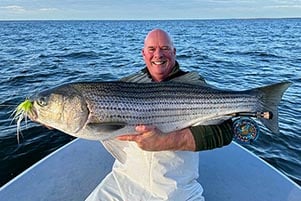
Bass, striped   Morone saxatilis  67 cm
Bluefish   Pomatomus saltatrix  59 cm
Bonefish   Albula spp.  50 cm
Bonito, Atlantic  Sarda sard   42 cm
Bonito, Pacific  Sarda spp   49 cm
Cobia   Rachycentron canadum 85 cm 
Corbina, California  Minticirrhus undulatus 33 cm 
Drum, black  Pogonias cromis  67 cm
Drum, red   Sciaenops ocellatus  72 cm 
Grouper, gag  Mycteroperca microlepis 66 cm 
Grouper, red  Epinephelus morio  42 cm 
Halibut, California  Paralichthys californicus 66 cm 
Jack, almaco  Seriola rivoliana  80 cm
Jack, crevalle  Caranx hippos  57 cm
Jack, horse-eye  Caranx latus  50 cm
Jack, Pacific crevalle  Caranx caninus  50 cm
Kahawai (Australian salmon) Arripis trutta  41 cm
Kawakawa   Euthynnus affinis  47 cm 
Ladyfish   Elops spp.   39 cm
Leerfish (Garrick)  Lichia amia  61 cm
Mackerel, narrowbarred  Scomberomorus commerson 100 cm
Mackerel, Pacific sierra Scomberomorus sierra 49 cm
Mackerel, Spanish  Scomberomorus maculatus 39 cm
Meagre   Argyrosomus spp.   30 cm
Permit   Trachinotus falcatus  52 cm
Pollock   Pollachius virens  56 cm
Pompano, African  Alectis ciliaris  58 cm
Queenfish, talang  Scomberoides commersonianus 60 cm
Rockfish, black/blue  Sebastes melanops  31 cm
Roosterfish  Nematistius pectoralis  81 cm
Samson fish  Seriola hippos  75 cm
Seabass, blackfin   Lateolabrax latus  47 cm
Seabass, Japanese (suzuki) Lateolabrax japonicus 63 cm
Seabass, white  Atractoscion nobilis  83 cm
Seatrout, spotted  Cynoscion nebulosus  50 cm
Shark, bonnethead  Sphyrna tiburo  50 cm
Skipjack, black  Euthynnus lineatus  42 cm
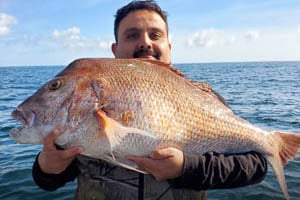
Snapper (squirefish)  Pagrus auratus  47 cm
Snapper, cubera  Lutjanus cyanopterus  69 cm
Snapper, Guinean  Lutjanus agennes  69 cm
Snapper, mullet  Lutjanus aratus  58 cm
Snapper, mutton  Lutjanus analis  45 cm
Snapper, Pacific cubera Lutjanus novemfasciatus 67 cm
Snapper, red  Lutjanus campechanus 48 cm
Snapper, yellowtail  Ocyurus chrysurus  34 cm
Snook, Atlantic  Centropomus spp.   25 cm
Snook, Pacific  Centropomus spp.  25 cm 
Tarpon, oxeye  Megalops cyprinoides  75 cm
Threadfin, giant African Polydactylus quadrifilis 100 cm
Threadfin, king  Polydactylus macrochir 83 cm
Trevally, bigeye  Caranx sexfasciatus  44 cm
Trevally, bluefin  Caranx melampygus  58 cm
Trevally, giant  Caranx ignobilis  76 cm
Trevally, golden  Gnathanodon speciosus 48 cm
Tripletail   Lobotes surinamensis  48 cm
Tuna, blackfin  Thunnus atlanticus  52 cm
Tuna, longtail  Thunnus tonggol  72 cm
Tuna, skipjack  Katsuwonus pelamis  49 cm 
Tunny, little  Euthynnus alletteratus 53 cm
Weakfish   Cynoscion regalis  48 cm
Yellowtail, California  Seriola lalandi dorsalis 80 cm
Yellowtail, southern  Seriola lalandi lalandi 78 cm

FRESHWATER SPECIES

Arawana   Osteoglossum bicirrhosum 41 cm
Barramundi  Lates calcarifer  62 cm
Bass, Australian  Macquaria novemaculeata 27 cm
Bass, largemouth  Micropterus salmoides 48 cm
Bass, smallmouth  Micropterus dolomieu  34 cm
Bass, striped (landlocked) Morone saxatilis  65 cm
Bass, white  Morone chrysops  24 cm
Bass, whiterock  Morone saxatilis M. chrysops 44 cm
Bluegill   Lepomis macrochirus1 19 cm
Bowfin   Amia calva  45 cm
Carp, common  Cyprinus carpio  55 cm
Carp, grass  Ctenopharyngodon idella 66 cm
Catfish, blue  Ictalurus furcatus  73 cm
Catfish, channel  Ictalurus punctatus  60 cm
Catfish, redtail (pirarara) Phractocephalus hemioliopterus 69 cm
Catfish, sharptooth  Clarias gariepinus  85 cm
Char, Arctic  Salvelinus alpinus  51 cm
Crappie, black  Pomoxis nigromaculatus 24 cm
Crappie, white  Pomoxis annularis  24 cm
Dolly varden  Salvelinus malma  50 cm
Dorado   Salminus maxillosus  55 cm
Gar, Florida  Lepisosteus platyrhincus 42 cm
Gar, shortnose  Lepisosteus platostomus 38 cm
Grayling   Thymallus thymallus  25 cm
Grayling, Arctic  Thymallus arcticus  37 cm
Kokanee   Oncorhynchus nerka  32 cm
Muskellunge  Esox masquinongy  76 cm
Nembwe   Serranochromis robustus 27 cm
Oscar   Astronotus ocellatus  19 cm
Payara   Hydrolicus scomberoides 53 cm
Peacock, blackstriped  Cichla intermedia  26 cm
Peacock, butterfly  Cichla ocellaris  33 cm
Peacock, speckled  Cichla temensis  45 cm
Perch, white  Morone Americana  21 cm
Perch, yellow  Perca flavescens  18 cm
Pickerel, chain  Esox niger   39 cm
Pike, northern  Esox lucius  68 cm
Salmon, Atlantic  Salmo salar  64 cm
Salmon, Atlantic (landlocked)  Salmo salar  46 cm
Salmon, chinook  Oncorhynchus tshawytscha 53 cm
Salmon, chum  Oncorhynchus keta  48 cm
Salmon, coho  Oncorhynchus kisutch  53 cm
Salmon, pink  Oncorhynchus gorbuscha 39 cm
Salmon, sockeye  Oncorhynchus nerka  35 cm
Shad, American  Alosa sapidissima  35 cm
Snakehead   Channa spp.  29 cm
Sorubim   Pseudoplatystoma spp. 52 cm
Taimen   Hucho taimen  78 cm
Tigerfish   Hydrocynus vittatus  43 cm
Tigerfish, giant  Hydrocynus goliath  64 cm
Trahira, giant  Hoplias macrophthalmus 26 cm
Trout, brook  Salvelinus fontinalis  34 cm
Trout, brown  Salmo trutta  51 cm
Trout, bull   Salvelinus confluentus  51 cm
Trout, cutthroat  Oncorhynchus clarki  44 cm
Trout, golden  Oncorhynchusa guabonita 35 cm
Trout, lake   Salvelinus namaycush  74 cm
Trout, rainbow  Oncorhynchus mykiss  54 cm
Walleye   Stizostedion vitreum  52 cm
Zander   Stizostedion lucioperca 43 cm