Massive Snook Catches
The Largest and Longest IGFA World Records

While most anglers view snook as a single, hard fighting sport fish, the reality is far more intricate, especially to the International Game Fish Association (IGFA). Within the Centropomus genus, the IGFA logs official records for distinct species and categories: Atlantic, Pacific, common, fat, Mexican, Pacific black, Pacific blackfin, Pacific white, swordspine, and tarpon snook.
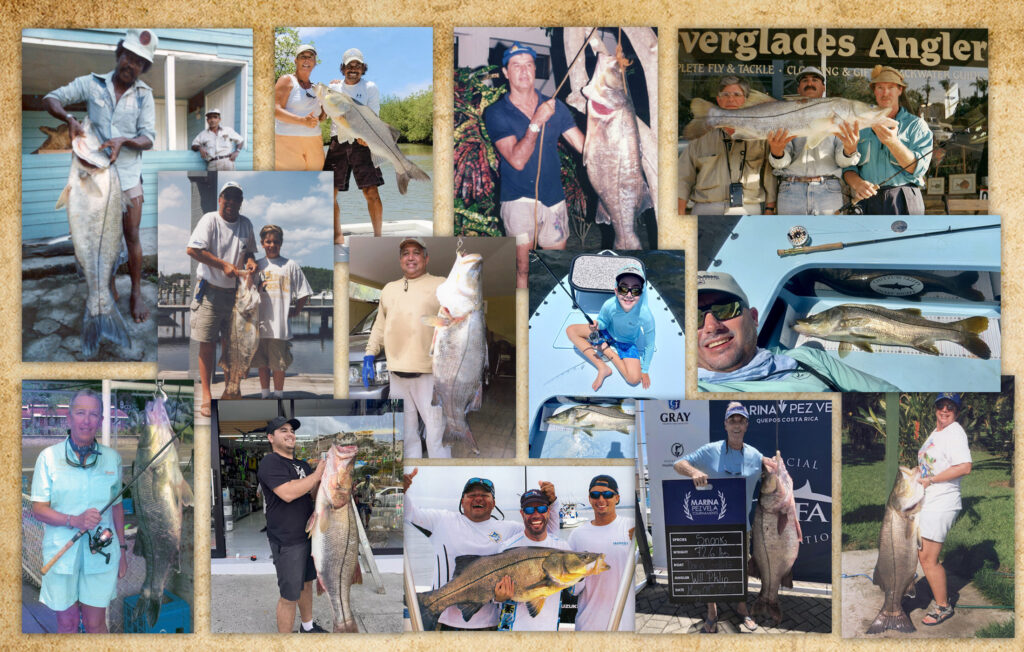
Most of these species remain lightweight scrapers under a few pounds. However, three heavyweights, the Atlantic common snook, the Pacific black snook, and the Pacific white snook, have smashed past the magical 22.68 kg (50 lb) mark. If you take even a quick look at social media posts relating to snook, the engagement is massive and unmistakable. These iconic linesiders are among the most treasured and fiercely targeted species in world record history, generating passionate debate and global enthusiasm across the angling community.
Before stepping onto the water, every serious angler must thoroughly understand and follow official IGFA rules. Tragically, extraordinary catches that would have stood as legend have been rejected simply because a leader was slightly too long, a line tested over the intended class, or a mate touched the rod and reel or mainline during the battle. A world record snook is the opportunity of a lifetime, and nothing hurts worse than landing the fish of your dreams only to watch it slip away on a technicality.
These documented catches represent the ultimate marks to beat, the highest achievements in precision, patience, and light tackle angling. Learn the rules, study these historic benchmarks, get out on the water, and see what you are truly capable of achieving. Here are the stories behind the largest snook catches ever documented in snook sportfishing history.
___________________
The Mystery Pacific Giant
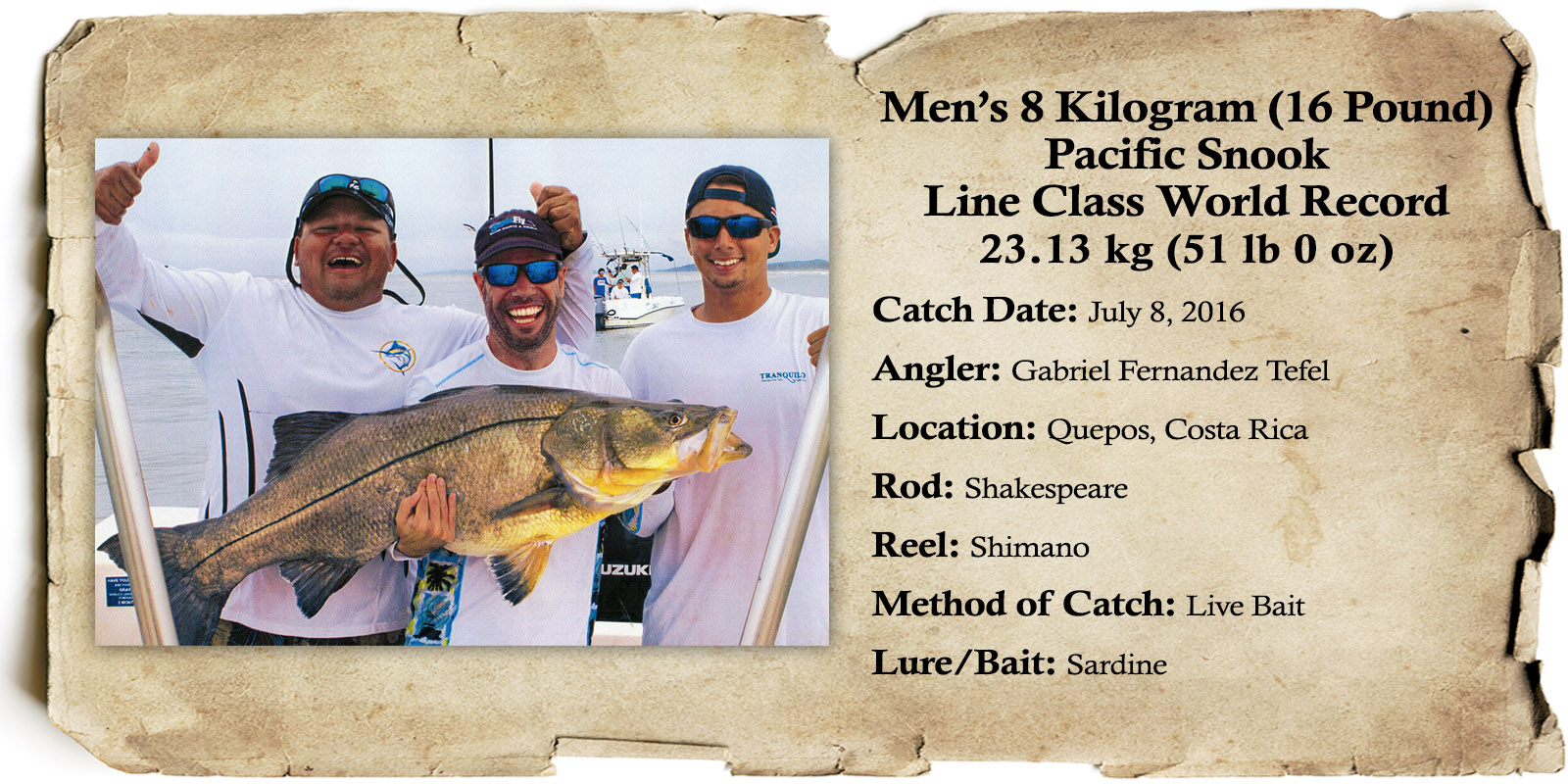
Heading out of Marina Pez Vela aboard the charter boat Chloe Frijole, North Carolina angler Gabriel Fernandez Tefel was looking for a solid day on the Pacific. What happened, he never could have suspected. A massive snook struck his live bait and took off, screaming drag. Battling the fish on light line, Tefel expertly maneuvered the monster alongside the boat in about 15 minutes. The boat then returned to Marina Pez Vela to be weighed on an IGFA-certified scale, where it officially registered at 23.13 kg (51 lbs.).
___________________
The Surf-Casting Surmiser
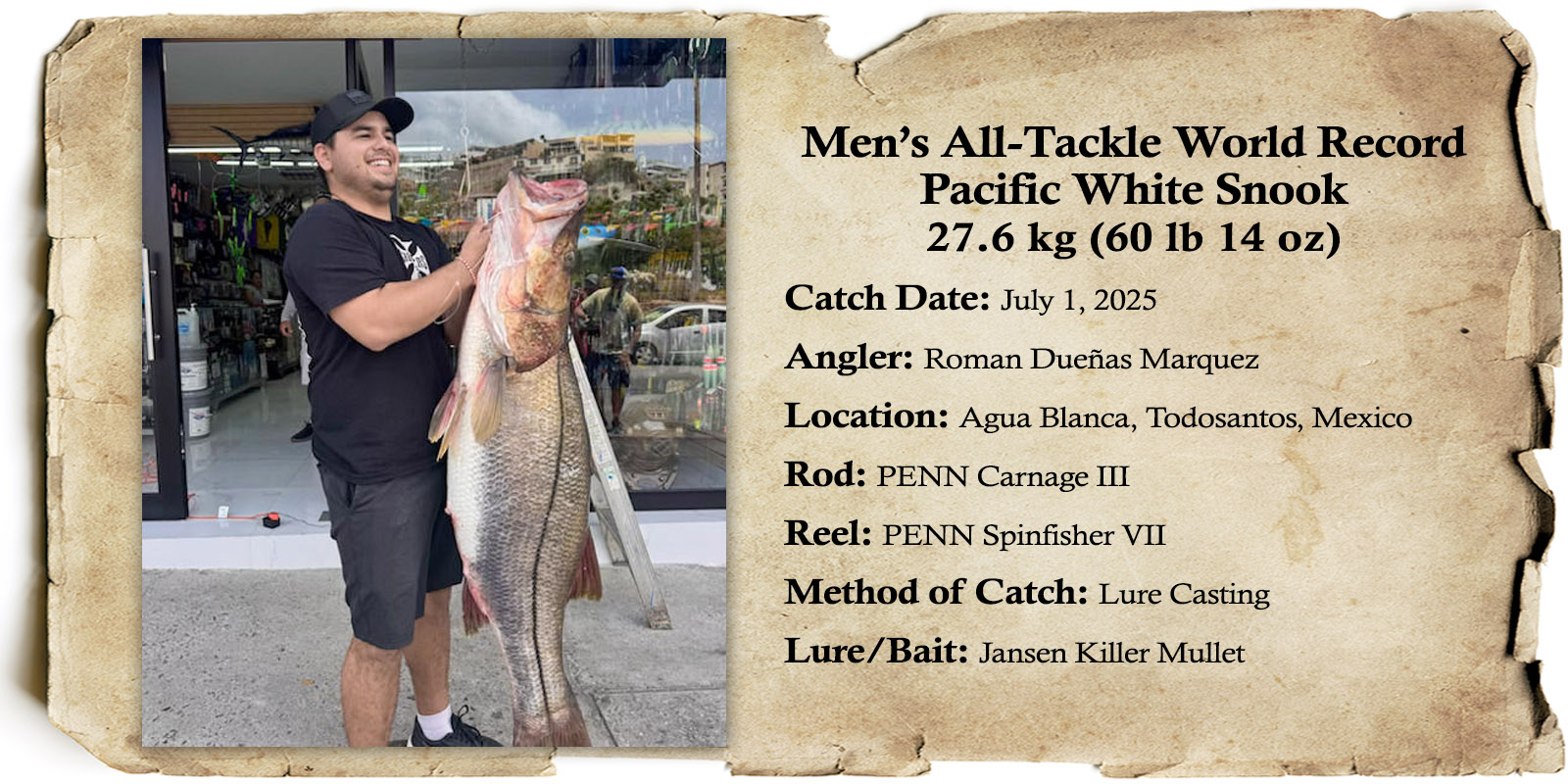
On July 1, 2025, angler Roman Dueñas Márquez set a new IGFA All-Tackle World Record by landing a 27.60 kg (60 lbs 13 oz) Pacific white snook (Centropomus viridis). Dueñas Márquez was surfcasting from the beach at Agua Blanca in Todos Santos, Mexico, using a Jansen Tackle mullet lure. He hooked the fish on a heavy-duty setup consisting of a PENN Carnage III rod paired with a PENN Spinfisher VII reel. After landing the monster linesider, Dueñas Márquez transported the fish to Minerva's Baja Tackle in Cabo San Lucas, where it was officially weighed on a certified scale. The IGFA officially approved the catch, cementing it as the premier Pacific white snook record and besting the previous 23.27 kg (51 lbs 5 oz) record set by surfcaster Wesley Brough in 2021.
___________________
The Largest Atlantic Snook Caught by a Female Angler
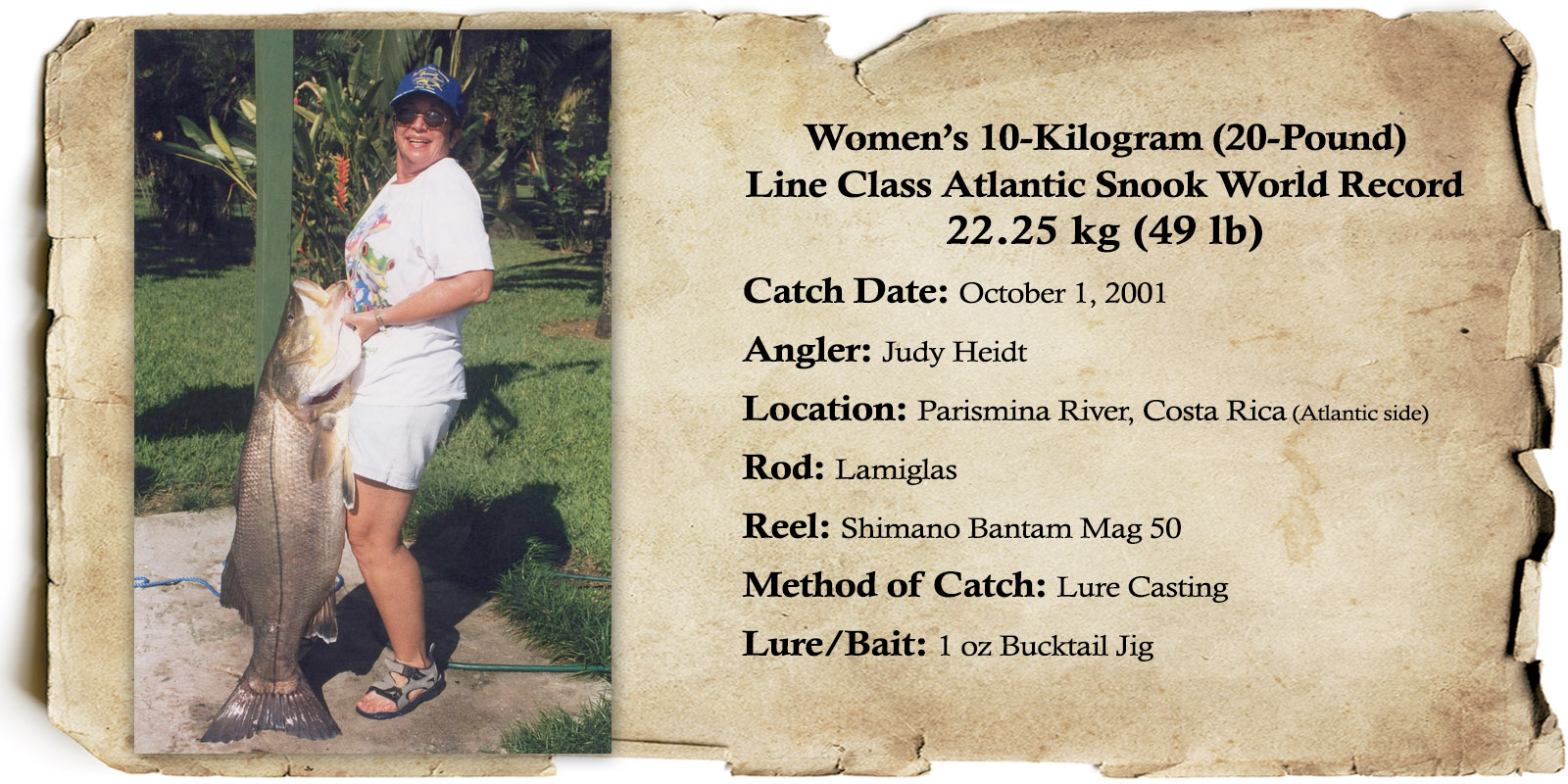
On September 14, 2004, angler Judy Heidt etched her name into angling history by landing a massive 22.22 kg (49 lbs 0 oz) Atlantic common snook (Centropomus undecimalis) while fishing the legendary Parismina River on the east coast of Costa Rica. Working a white bucktail jig near the river mouth, Heidt hooked into a colossal fish that immediately put her gear to the ultimate test. She skillfully navigated a grueling 25 minute battle in the heavy river current before bringing the giant safely to hand. Her outstanding catch earned the IGFA Women's 10 kg (20 lb) Line Class World Record for the species and remains celebrated as the largest Atlantic snook ever landed by a female angler.
___________________
Two Records in Two Days
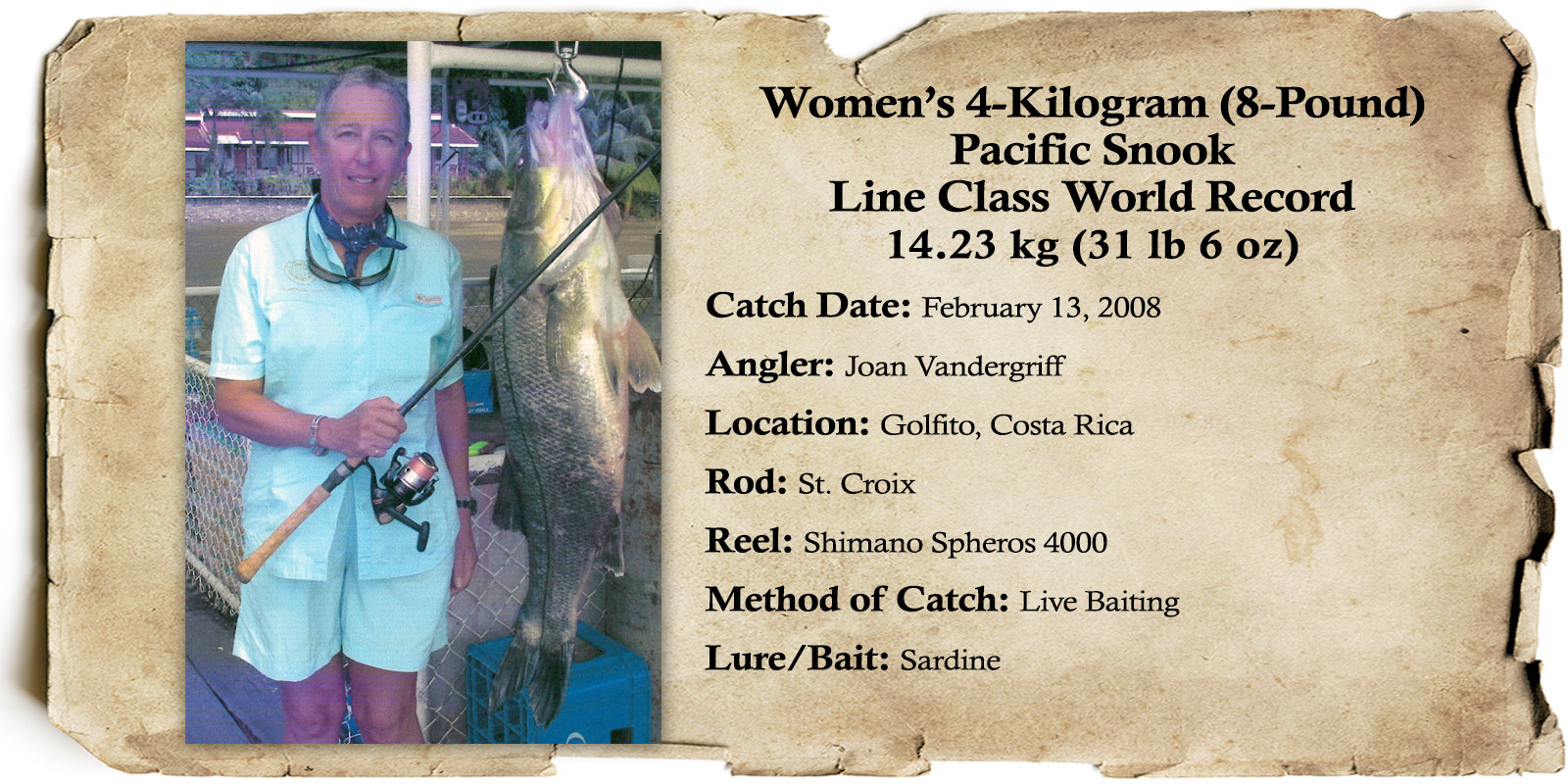
Catching one world record is a great achievement; catching two in two days is another thing entirely. On February 12, 2008, Joan Vandergriff was fishing in Golfito, Costa Rica, when what would be her first IGFA World Record Pacific snook took her bait. After a great fight, the fish was brought to hand: an 8.93 kg (19 lbs 11 oz) Pacific snook, which set the women's 9 kg (20 lb) line class world record, breaking the previous record by nearly 5.44 kg (12 lbs). The very next day, she outdid herself. Vandergriff hooked into a beast of a snook, which, after a tense fight, was finally landed. This fish weighed 14.23 kg (31 lbs 6 oz) and set the women's 4 kg (8 lb) line class record, eclipsing the previous record by nearly 10.43 kg (23 lbs).
___________________
Another Amazing Golfito Catch
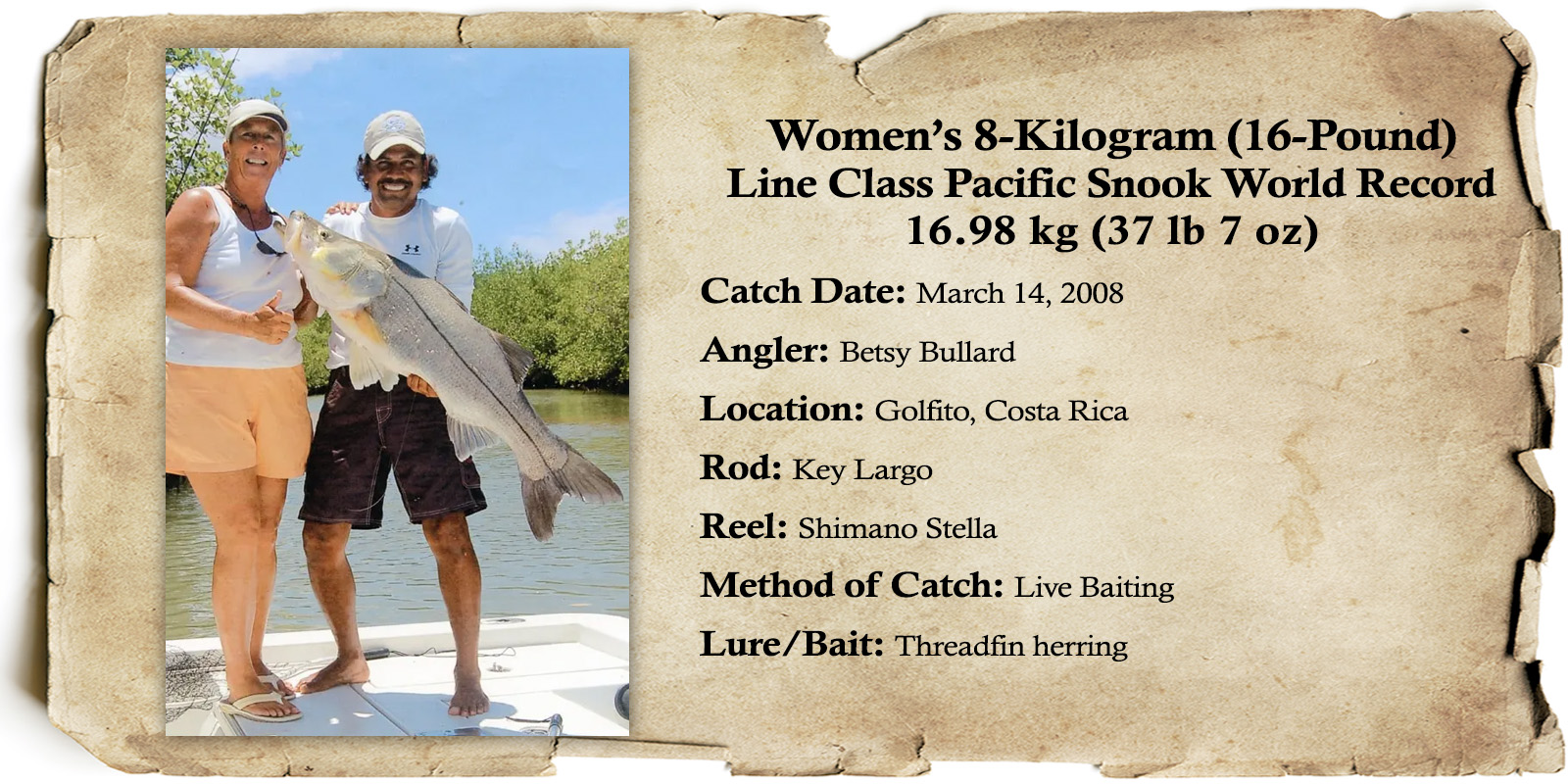
On March 14, 2008, angler Betsy Bullard added another major accomplishment to her storied fishing career while targeting snook in the rich, structure-filled waters of Golfito, Costa Rica. Spooled with light 8 kg (16 lb) line, Bullard’s gear was pushed to its absolute limit the moment a massive Pacific snook struck her bait. Landing a powerful snook on light line requires a delicate touch; one sudden surge into the mangrove roots or submerged cover can instantly snap the monofilament. Bullard managed the intense, high-stakes battle with surgical precision, coolly working the fish to the boat. The trophy specimen weighed in at an impressive 16.98 kg (37 lbs 7 oz), earning her an official IGFA World Record in the women's 8 kg (16 lb) line line class category.
___________________
The Atlantic Snook Benchmark
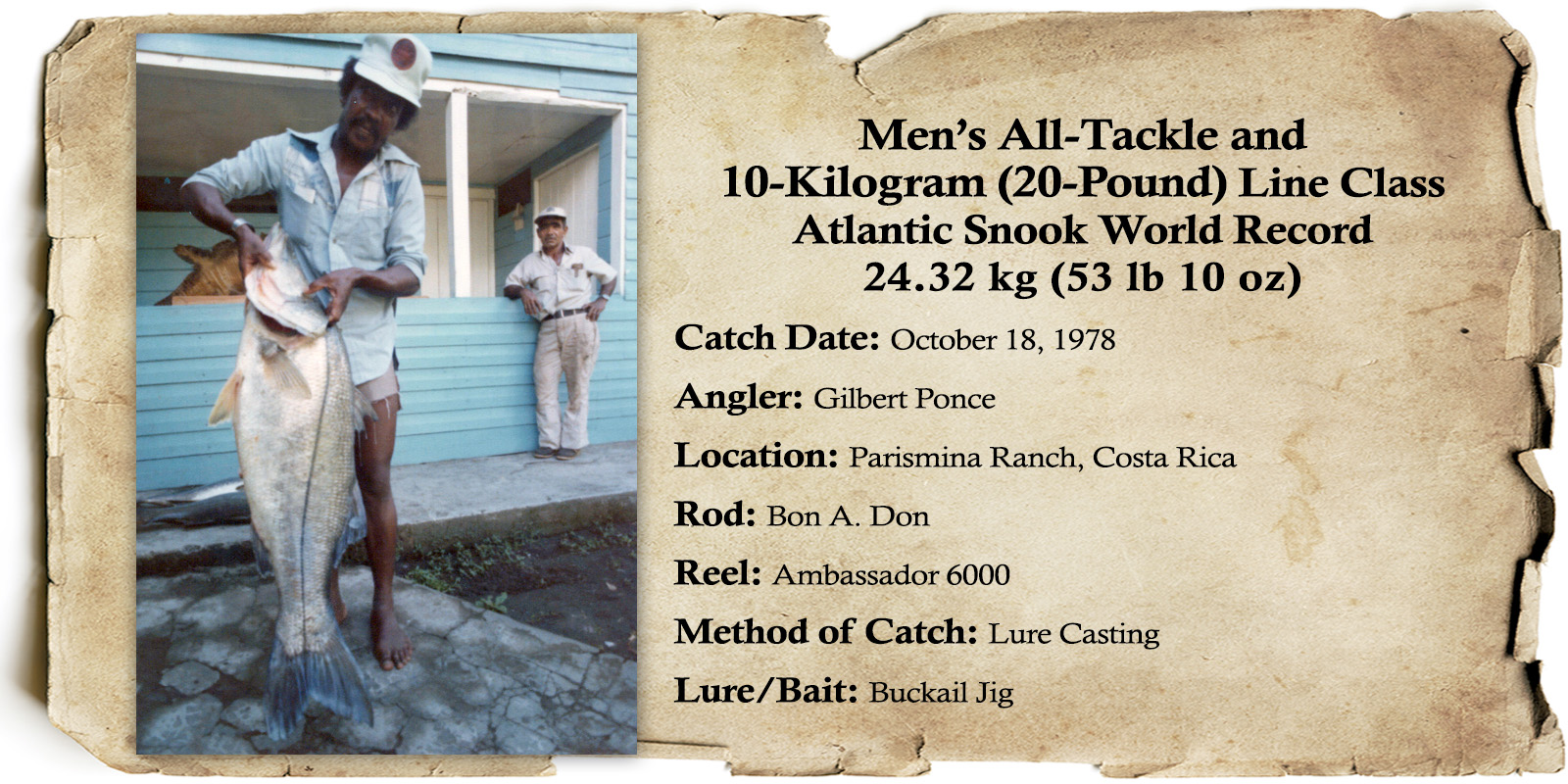
On October 18, 1978, angler Gilbert Ponce set a historic benchmark on Costa Rica’s Caribbean coast, a region legendary for massive tarpon that also produces gigantic Atlantic common snook (Centropomus undecimalis). Ponce was working a bucktail jig at Parismina Ranch, attached to 10 kg (20 lb) test monofilament line spooled on an Ambassadeur baitcasting reel, when he hooked into a true monster. Severely undergunned, Ponce endured a nerve-wracking 45-minute fight in the river currents before bringing the 24.32 kg (53 lbs 10 oz) fish to shore. The catch earned Ponce two distinct IGFA achievements: it secured the men's 10 kg (20 lb) line class world record for Atlantic Snook, and because no larger specimen had ever been caught by IGFA standards, it also captured the prestigious All-Tackle World Record for common snook. Decades later, it remains the largest common snook ever recorded in the IGFA books.
___________________
The Light-Tackle River Beast
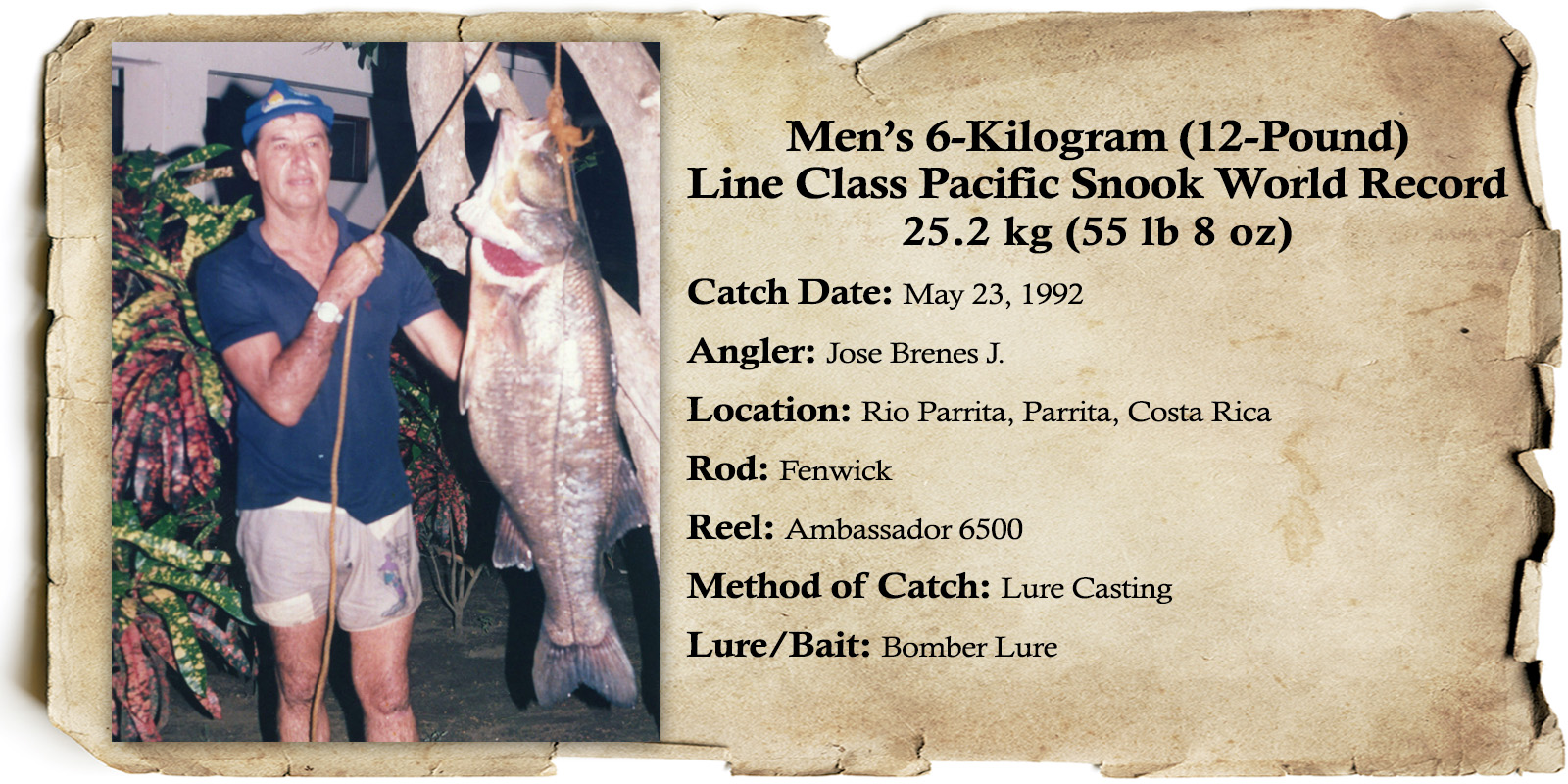
On March 26, 1993, angler Jose Brenes tackled the churning waters where freshwater rivers dump into the Pacific surf at the mouth of the Río Parrita in Costa Rica. Firing artificial lures into the heavy current, Brenes connected with a fish that surged into the foam and almost emptied his spool. Spooled with delicate line on a lightweight setup, he played the monster with masterclass finesse, carefully nursing the drag to keep the line from snapping against the river’s undertow or the fish's sharp gill plates. In just 20 minutes of intense, high-stakes maneuvering, Brenes landed a 25.17 kg (55 lbs 8 oz) Pacific black snook (Centropomus nigrescens). The catch earned him an official IGFA World Record in the men's 6 kg (12 lb) line class category for Pacific Snook, proving what surgical light-tackle finesse can achieve in challenging conditions.
___________________
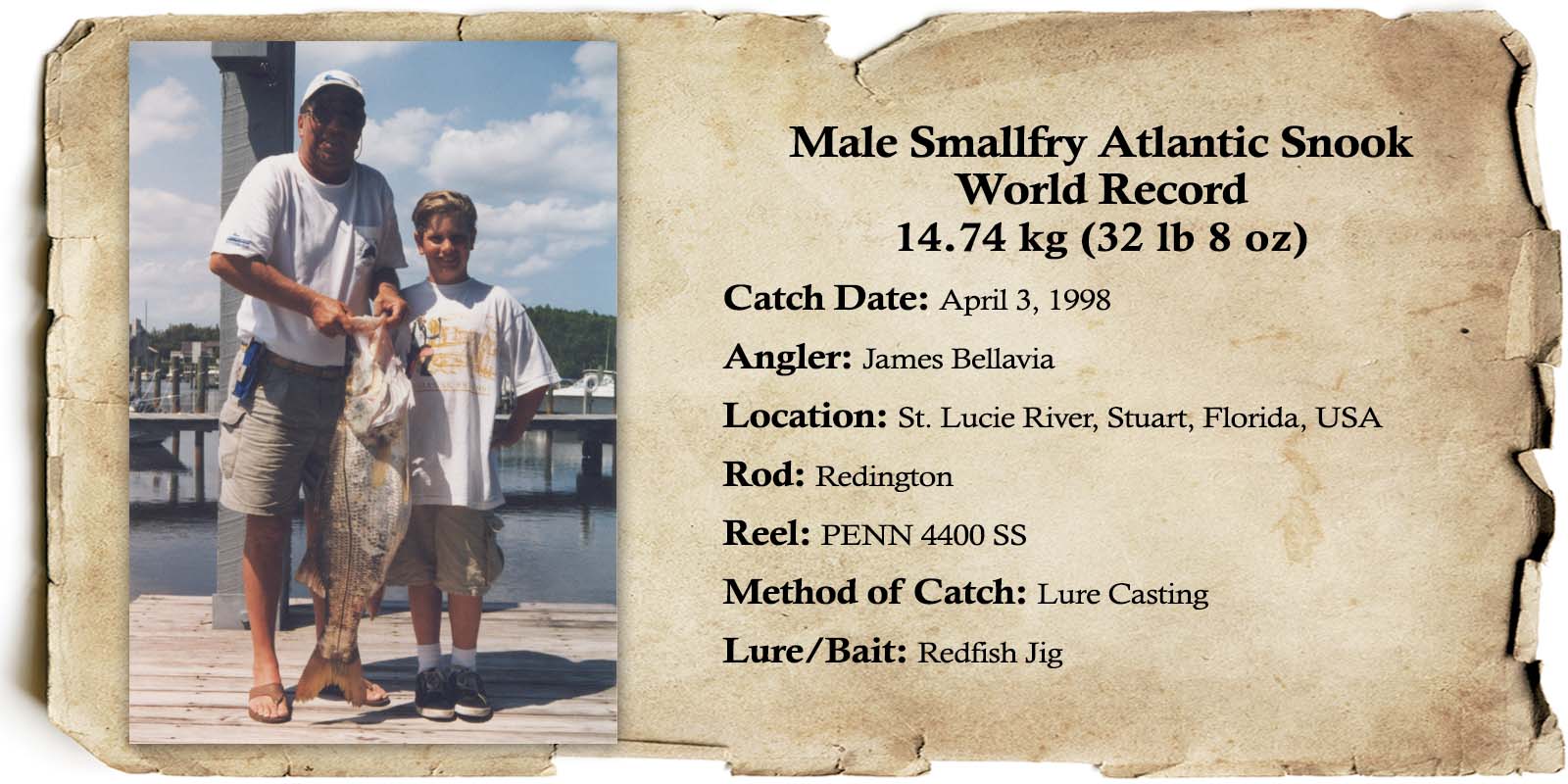
The Largest Male Smallfry Atlantic Snook on Record
On April 3, 1998, young angler at the time, James Bellavia, landed a 14.74 kg (32 lbs 8 oz) common snook measuring 111.76 cm (44 inches) in length with a girth of 58.42 cm (23 inches) in the St. Lucie River near Stuart, Florida. Bellavia caught the fish using light tackle by casting a Redfish Jig on a Redington rod paired with a Penn 4400 SS spinning reel spooled with 10 lb test Ande monofilament line, requiring precise drag control to avoid line breakage against underwater cover or the sharp gill plates of the fish. The catch earned Bellavia the Male Smallfry Record for Atlantic Snook.
___________________
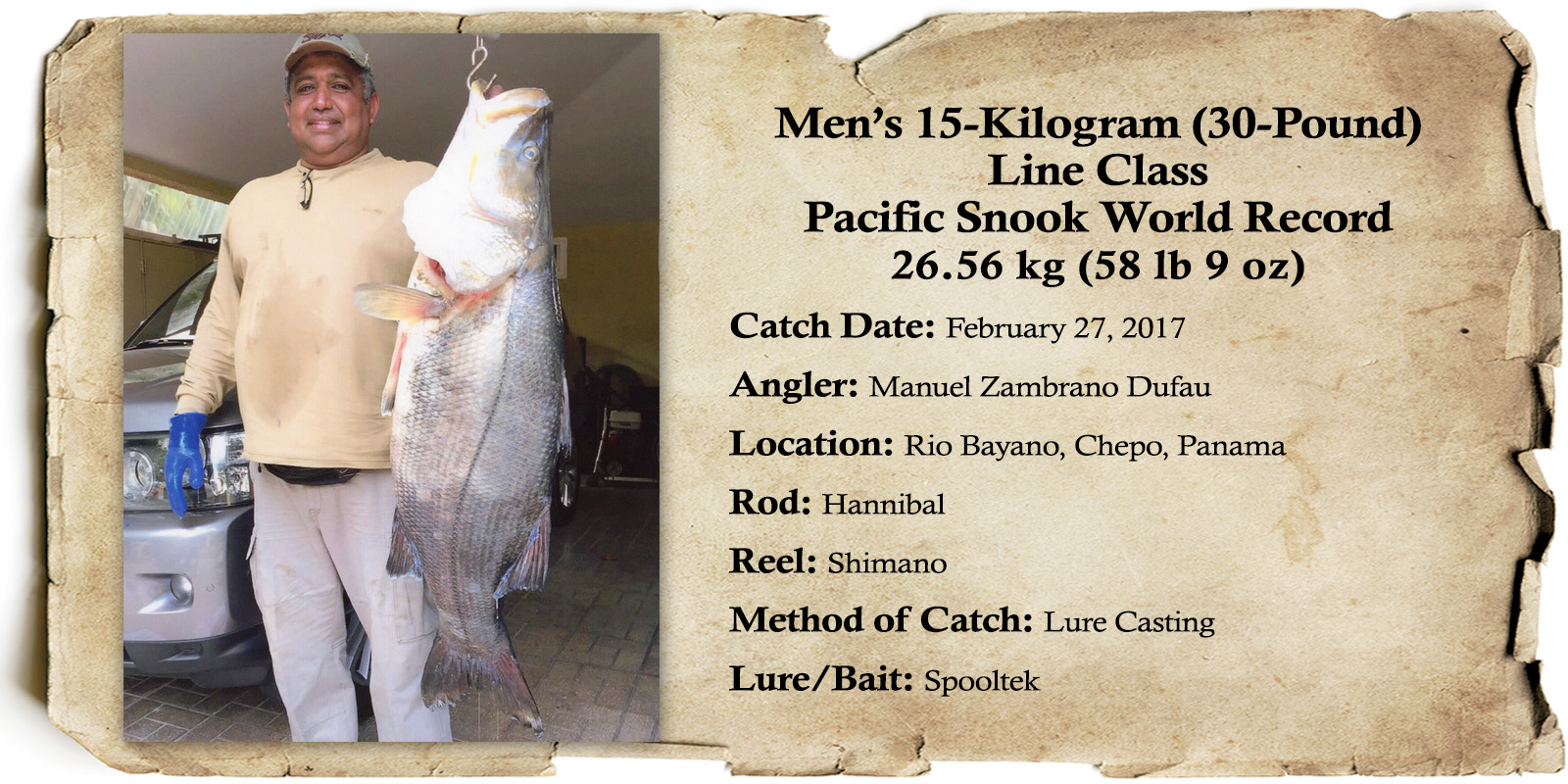
The Lure-Caught Giant
In February 2017, angler Manuel Zambrano Dufau demonstrated that you do not need a high tech center console to catch a world record when he fished Panama’s Río Bayano from a traditional 28 foot wooden dugout canoe. Pitching a 9 inch Spooltek Stretch swimbait on test Spiderwire braid, which officially tested into the 15 kg (30 lb) line class category, Dufau set the hook into a titanic Pacific black snook (Centropomus nigrescens). After a tense 15 minute battle fought directly from the dugout, he boated a 26.56 kg (58 lbs 9 oz) giant. The catch secured Dufau the men's 15 kg (30 lb) line class world record and earned the official IGFA title for the largest snook ever taken on an artificial lure.
___________________
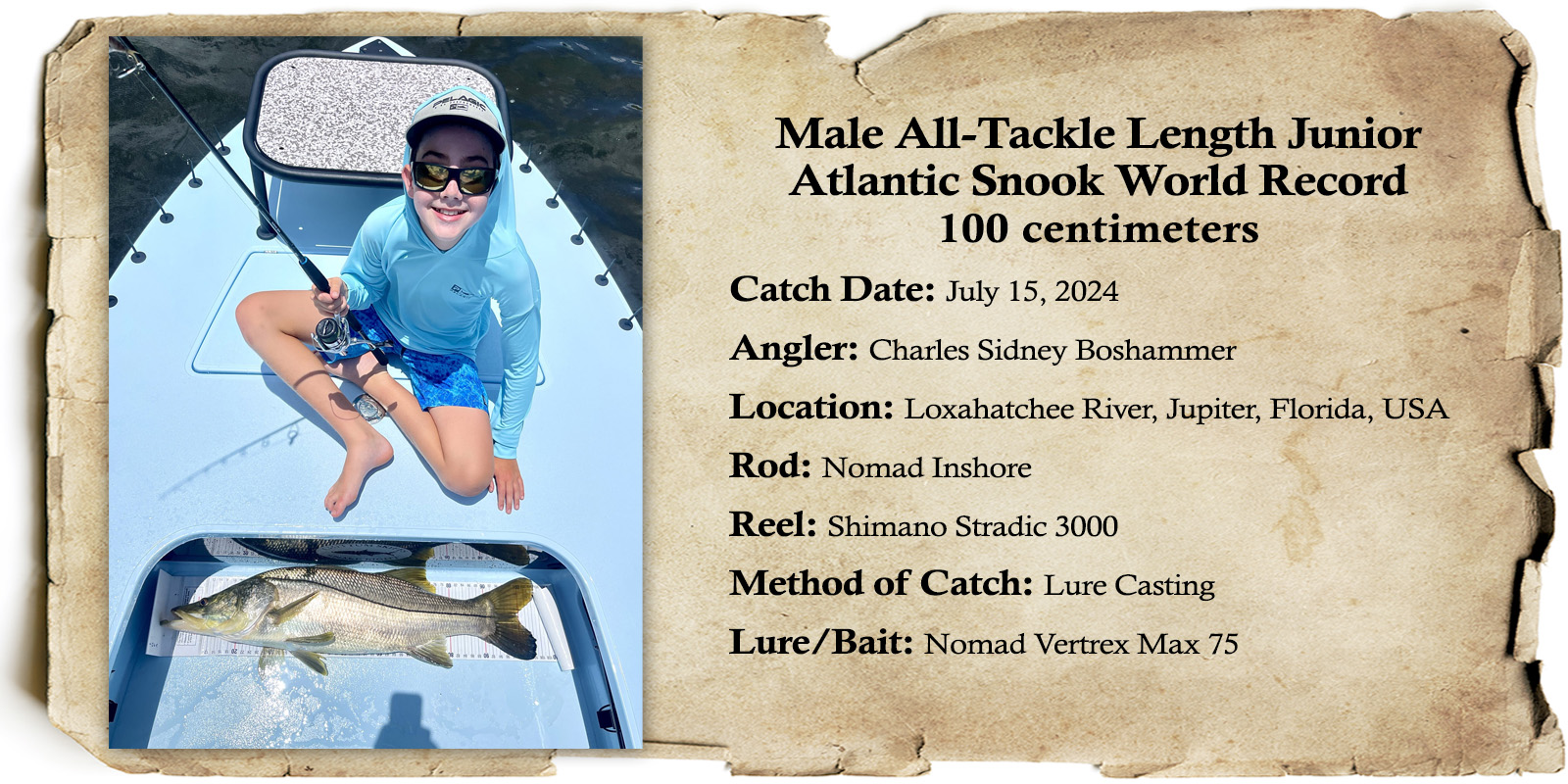
A Giant for Charles
The Loxahatchee River in Jupiter, Florida, is known for producing large snook. On July 15, 2024, Charles Boshammer joined in on the fun. Fishing with his father, IGFA Captain Jarad “Dingo” Boshammer, he hooked into what would become a record fish. He was working a Nomad Vertrex lure when the snook slammed his offering. After a spirited fight, he brought the fish to hand. Upon measuring it on an official IGFA measuring device, it measured 100 centimeters, setting the IGFA All-Tackle Length Junior World Record for Atlantic snook. The fish was released to fight another day.
___________________
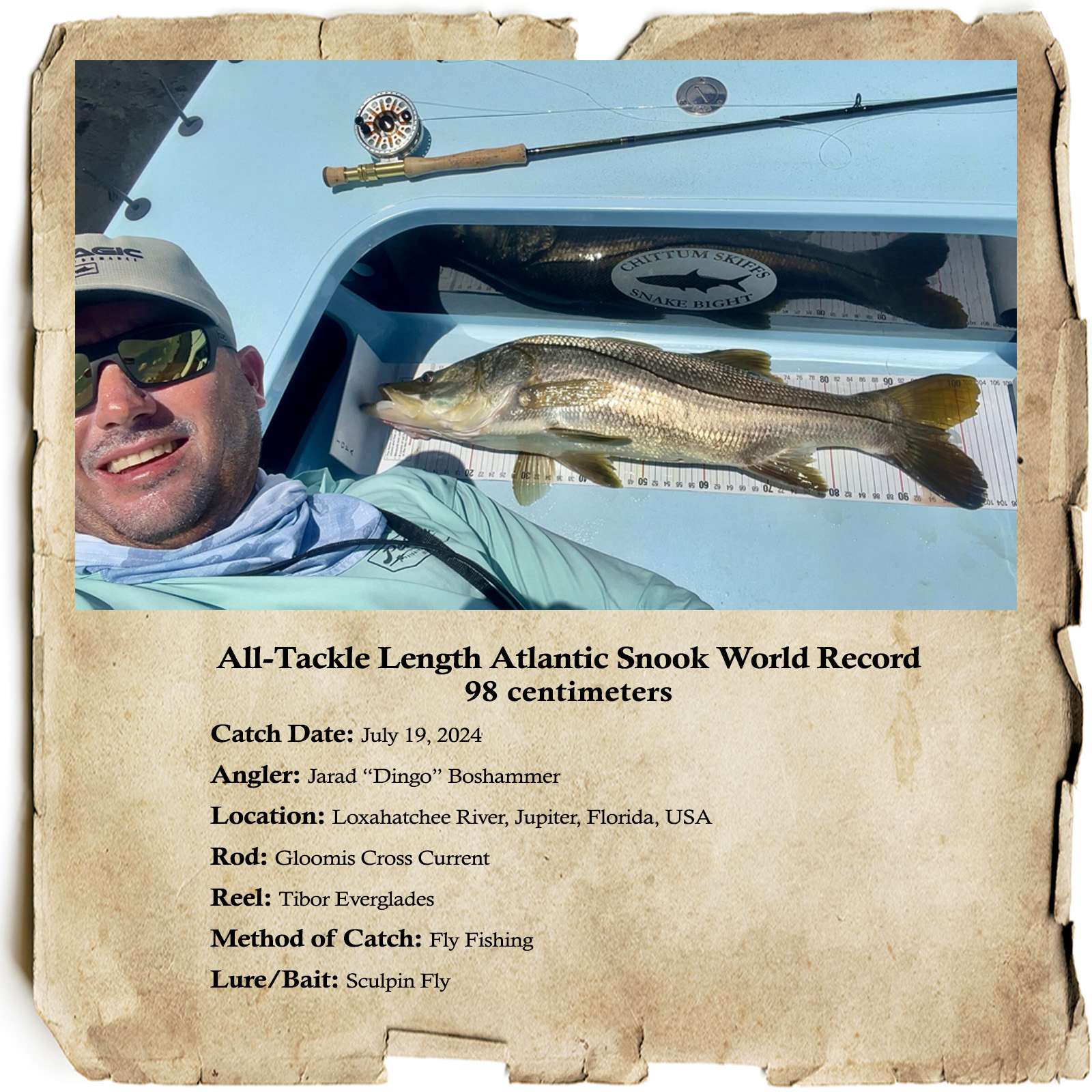
Dingo's Fly All-Tackle Length Record
Not to be outdone, IGFA Captain Jarad “Dingo” Boshammer was again fishing the Loxahatchee River in Jupiter, Florida, when he left his mark in the IGFA record books. Captain Boshammer was fly fishing and fed a massive snook, which he landed and subsequently measured on an official IGFA measuring device. The snook measured 98 centimeters, two centimeters shy of his son’s record, enough to set the mark for the All-Tackle Length Fly World Record. The catch came just four days after his son set the All-Tackle Length Junior World Record. The fish was also released safely to fight another day.
___________________
An Everglades Beast on Fly
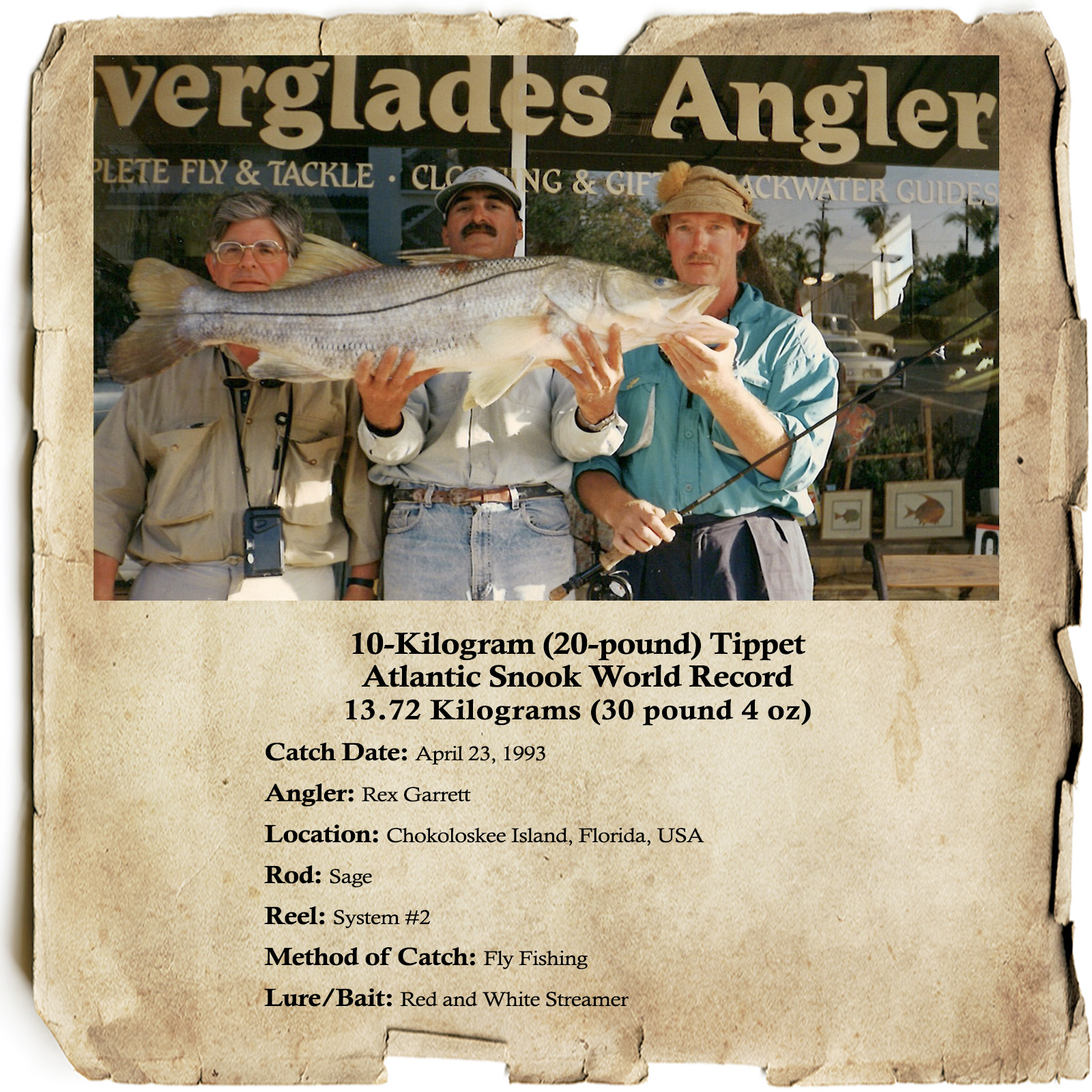
On April 23, 1993, Rex Garrett was fishing Chokoloskee Island, Florida, when he had a record setting day. It is no secret that snook are a popular target for fly anglers in the Everglades, and Garrett took full advantage. He was working a streamer fly on a 9.07 kg (20 lb) tippet setup when a massive snook engulfed his offering. When the fight was said and done, he brought the fish to be weighed on an IGFA certified scale, where it registered at 13.72 kg (30 lbs 4 oz). The catch set the men's 10 kg (20 lb) tippet class world record, which still stands today.
___________________
The Grand Champion of All Snook
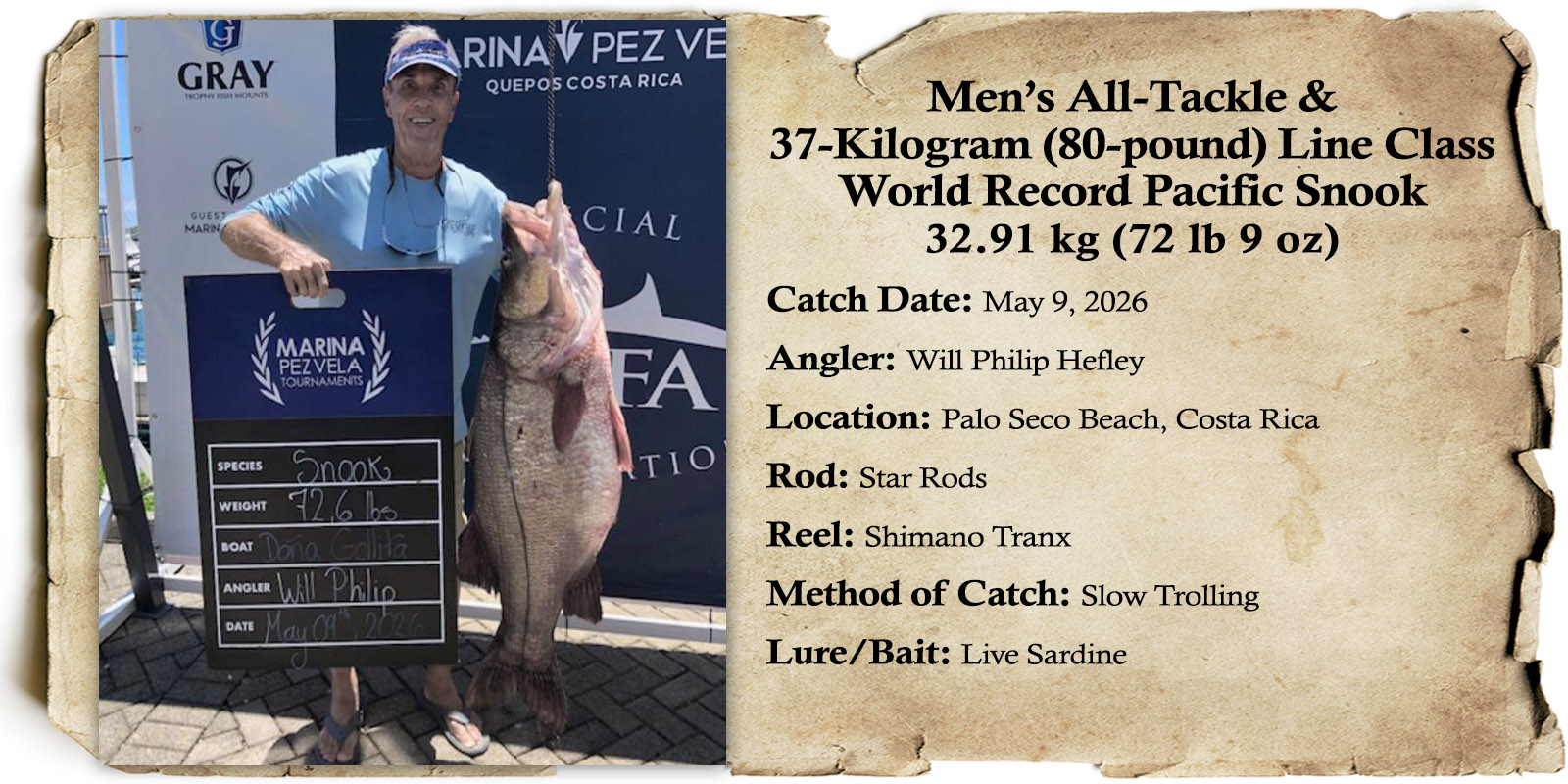
The absolute pinnacle of sportfishing snook records belongs to Will Philip Hefley. On May 9, 2026, Will landed a massive 32.88 kg (72 lbs 8 oz) Pacific black snook (Centropomus nigrescens) while fishing out of Marina Pez Vela in Quepos, Costa Rica. The snook struck a live sardine and was boated after an intense fight. Will then returned to Marina Pez Vela, an Official IGFA Weigh Station, for an official weight on a certified scale. This snook is the heaviest snook the IGFA has ever recorded and eclipsed the previous All Tackle Pacific snook record by over 5.89 kg (13 lbs). The remarkable catch earned Hefley two distinct IGFA achievements: it secured the men's 37 kg (80 lb) line class world record for Pacific black snook, and because no larger specimen of any snook species has ever been logged, it also captured the prestigious All Tackle World Record.
___________________
The IGFA Trophy Snook Club
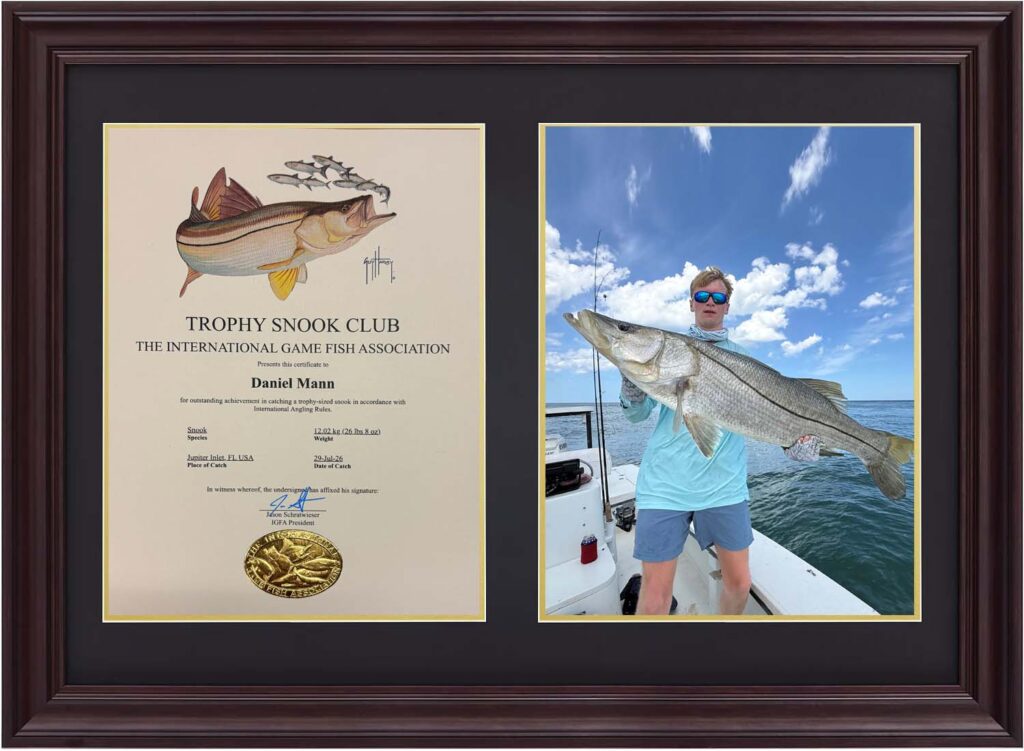
Even if your snook doesn’t break a 50-pound World Record, landing a memorable fish still deserves official recognition. Through the IGFA Trophy Fish Clubs, anglers who catch outstanding specimens can have their achievement officially documented and celebrated.
What is the IGFA Trophy Snook Club?
The Trophy Snook Club is part of the IGFA’s special recognition program designed to honor catches of exceptional size—without needing to top the global record books. It bridges the gap between a standard catch and a world record, giving recreational anglers a permanent place in IGFA history.
- Minimum Size Requirements: To qualify, your snook must meet specific threshold standards set by the IGFA:
- Weight Category: Minimum of 11.3 kg (25 lb)
- Length Category (Catch-and-Release): Minimum of or 100 cm (39.4 in) fork length. From the tip of the snout to the rear center edge of the tail (fork length)
- Catch & Release Friendly: You don’t have to kill a trophy fish to earn recognition. The IGFA offers length-based entries measured on an official IGFA bump board, allowing you to quickly photo-document the snook and release it alive.
- Official Recognition: Anglers admitted into the club receive an official, personalized IGFA Trophy Snook Club Certificate, an embossed decal, and a permanent listing in the IGFA’s digital archives.
Whether caught on fly, light tackle, or conventional gear, submitting your trophy catch supports global game fish conservation records while cementing your personal personal-best in angling lore.